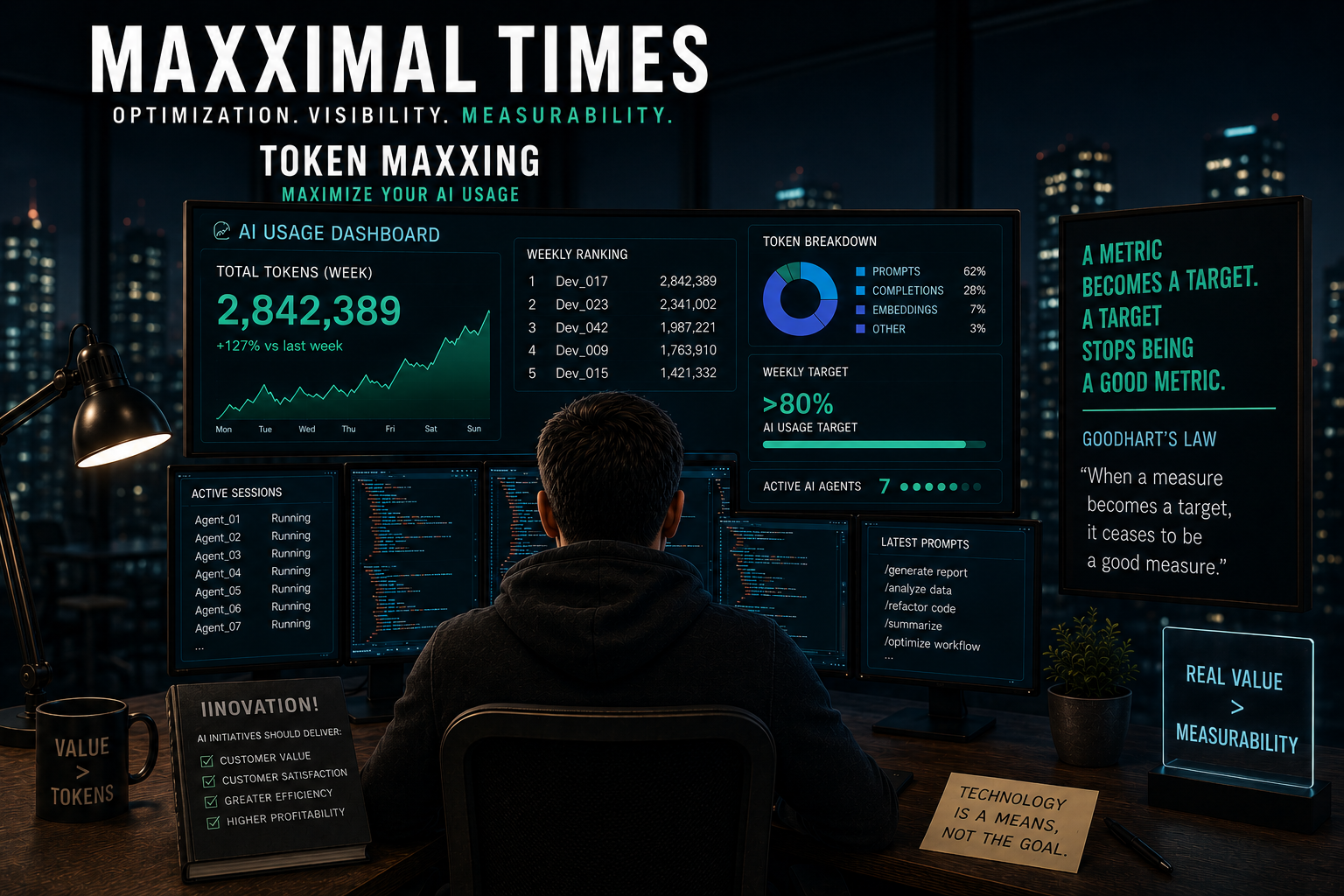
We live in ‘maxximal’ times. Due to a development called ’token maxxing.’ It fits within a broader zeitgeist in which optimization, visibility, and measurability have become more important . But is a phenomenon like ’token maxxing’ actually a good development for measuring productivity? And what does it mean for innovation in times of ’token maxxing’? Do innovation and ’token maxxing’ even go well together?
‘Token maxxing’ or ’token maxing’ is a measurement method used to track workplace productivity, especially among employees who use artificial intelligence (AI)-based services. AI services charge costs per token. Tokens represent units of computational effort delivered by an AI service to solve a problem. Some companies and individuals assume that higher token consumption equals higher productivity. As a result, they use it as a metric (KPI) to monitor employee performance.1
‘Token maxxing’ in the AI-sphere
‘Token maxxing’ originates from the AI-sphere and refers to the broader social, technological, and economic ecosystem surrounding AI. The AI-sphere consists of companies, users, developers, researchers, influencers, communities, media, and cultural trends that develop, use, discuss, or shape AI technologies.
Supporters believe that higher token consumption indicates greater productivity and more intensive use of powerful AI services.
Critics of ’token maxxing’ as a KPI argue that rational employees will maximize any metric management considers important in order to gain an advantage in the workplace.
For example, engineers in the technology sector who are under pressure to consume as many tokens as possible may deploy multiple AI agents simultaneous. They enter unnecessarily long prompts, or automate additional tasks simply to increase token usage. To management, this higher token consumption may appear to indicate greater productivity. However, in reality it may lead to higher token costs, employee burnout, or bloated lower-quality code.
Other critics argue that providers of AI services may benefit from this focus on token consumption. And may actively encourage the trend.
‘Token maxxing’ within Amazon
And now Amazon employees themselves appear to have started ’token maxxing,’ precisely because of the pressure to use AI tools. They are using an internal AI tool to automate non-essential tasks in an attempt to demonstrate to managers that they are using the technology more frequently. In recent weeks, Amazon has begun rolling out its internal product ‘MeshClaw’ at scale.
Some Amazon employees claim that colleagues are using the software to automate unnecessary AI-driven activities so their token consumption increases. This reflects internal pressure within Amazon to adopt the technology after Amazon introduced targets requiring more than 80 percent of developers to use AI weekly. Earlier this year, the company also began internally tracking AI token usage through executive leaderboards.2
‘When a measure becomes a target, it ceases to be a good measure.’ – Goodhart’s Law
Goodhart’s Law
The developments at Amazon appear to confirm Goodhart’s Law. Goodhart’s Law states: ‘When a measure becomes a target, it ceases to be a good measure.’3
This also means that innovation and ’token maxxing’ do not necessarily form an healthy relationship once the KPI of ’token maxxing’ becomes dominant.
Higher customer value, higher customer satisfaction, more efficiency, and more profit through AI-driven innovation
The use of AI has become inseparable from innovation in times of ’token maxxing’. And AI certainly offers many opportunities for innovation. But ’token maxxing’ as a KPI for measuring productivity and innovation is a misguided development. In this situation, the use of a new technology is no longer a means to an end, but becomes the goal itself. And that completely misses the point of innovation.
In my book Innoventie! (in Dutch only, for now), I wrote that every AI initiative should contribute to greater customer value, higher customer satisfaction, improved efficiency, and increased profitability. Especially when it comes to innovation in times of token maxxing.
‘Token maxxing’ is the wrong objective for achieving those goals. In fact, since AI services are not free, it will ultimately only result in higher costs.
‘Token maxxing’ may sound like mere internet jargon, but it says a great deal about our era, in which AI continues to dominate news cycles. An era in which work, technology, and even human value are increasingly judged through metrics, rankings, and visible performance.
The real question, however, is this: are we truly optimizing value — or merely optimizing its measurability?